
🥃 Whisky Gate - The Birth of Glayva
How many times I’ve walked past these gates is anyone’s guess. Most people today, hurrying along this street on their way to some hipster bar, give them neither a second glance nor a moment’s thought.

Yet, as gates go, they are rather important. Not so much for what was made in the warehouses beyond them, but more for when it was made. And why.
Look closely and you’ll see the letters R M in the centre.

These stand for Ronald Morrison: wine and spirit importer; Scotch whisky blender; Scotch whisky exporter; grocer; cork importer and exporter; cask broker - you name it and Ronald probably dabbled in it.
He wasn’t the only famous Scotch whisky name to have been based here. The same address - 100 Constitution Street - was also the office premises for William Sanderson and John Bertram, amongst others.
And interestingly, his name wasn’t actually Ronald Morrison.
John Ronald Scott Morrison was born in 1906 in Edinburgh, the son of a grain merchant. He applied his entrepreneurial spirit in many, many ways - as you can see below - when in 1946, he established the private limited company of Ronald Morrison & Co:

Despite this huge list of business interests, the one thing that made his name, and hence his fortune, is noticeably absent: whisky liqueurs. And Ronald Morrison’s whisky liqueur was called Glayva.

Created in 1947, the marketing spiel on the brand’s website outlining Glayva’s history includes phrases such as bold experimentation… expertise and connections to obtain the very specific malts he had in mind… concocting a tempting new liqueur for his loyal customers... yada yada yada.
But remember, this was post-war Leith.
During the Second World War, distilleries were tightly restricted as to how much spirit they could produce. Distilling did continue, but not necessarily for whisky; much of it was diverted to the manufacture of industrial alcohol for munitions.
Barley and other grains were rationed too.
So, by 1946, stocks of Scotch whisky - and particularly older whiskies - had been severely depleted.
Britain, meanwhile, emerged from the war in need of cash. Domestic consumption of whisky fell as increasing volumes were earmarked for export, with the United States (and its dollars) becoming a crucial market.
So, here’s my theory. Obtaining the very specific malts he had in mind would have been no small challenge, and any whisky he could lay his hands on would almost certainly have been young. And probably harsh. The addition of ingredients such as tangerines, honey, and cinnamon would have softened those edges, making the drink, let’s say, more palatable.
And while I might question the accuracy of the information on the website, fair play to the man all the same. Because although I know you’re here for the whisky - and probably not the whisky liqueurs - Ronald Morrison created a distinctly Scottish drink that went on to enjoy worldwide success and, through export, brought in much-needed cash at a critical moment.

Although Glayva was what both the man and the company became best known for, Ronald Morrison & Co. continued to operate the blending side of the business. The only whisky I’ve had the opportunity to taste that was blended and bottled by them is this bottle of Knight Cap from the 1970s:
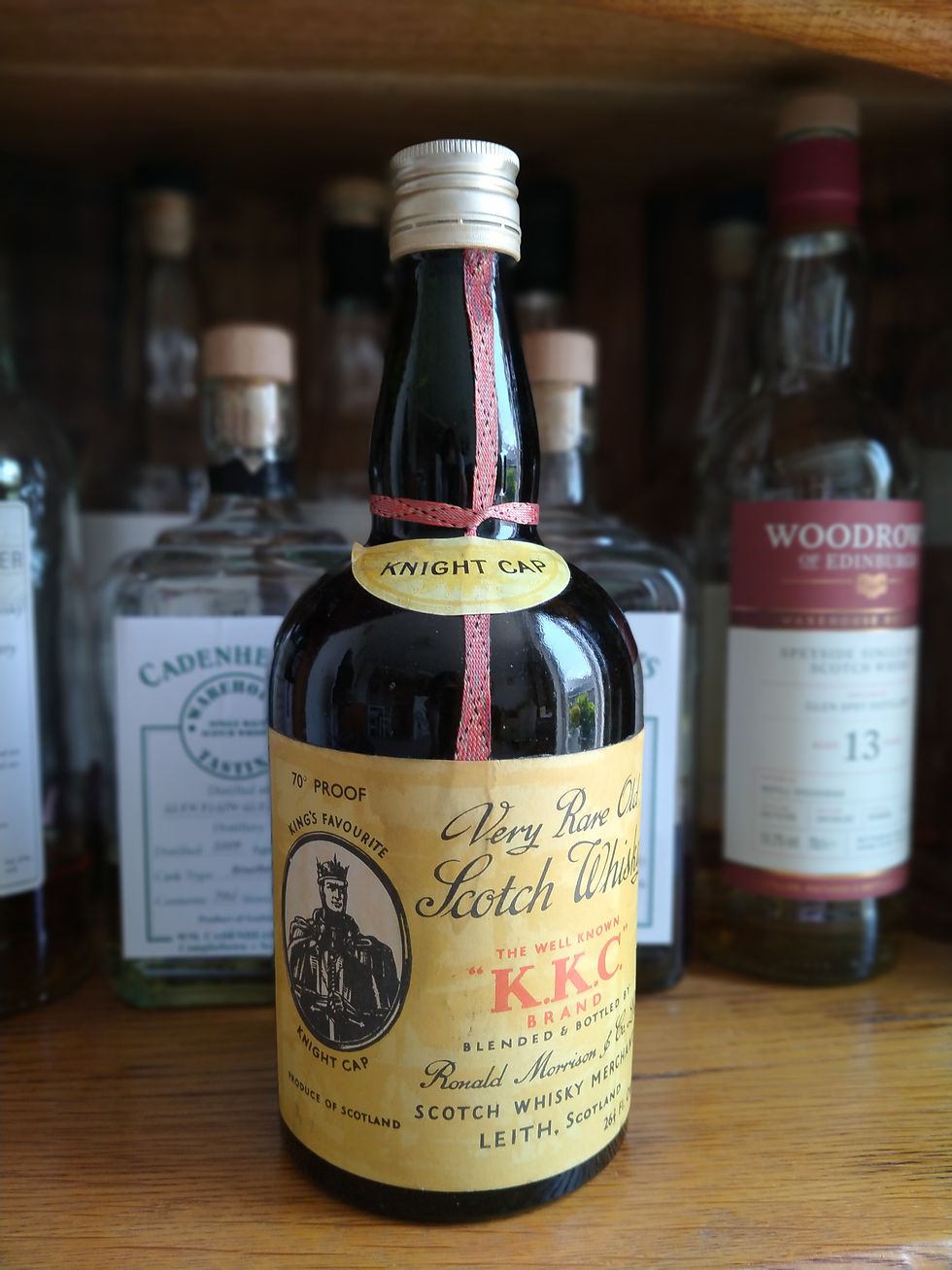
This would have been bottled shortly after Morrison himself died in 1973.
His son, Michael, took over as chairman and continued in that role after 1984, when the company was sold to Invergordon Distillers for £232,500 which is the equivalent to just over three-quarters of a million today. That might not sound like much, but by this point Invergordon was already producing Glayva for Ronald Morrison & Co., meaning they were essentially buying the brand itself rather than any significant physical assets, of which there were few.
I can’t help but feel that this whisky liqueur (something many might turn their noses up at, myself included) was at the centre of a pivotal moment in Scotch whisky’s history. Post-war shortages of whisky stocks forced Ronald Morrison’s hand. He saw an opportunity to create something that would prevent his business from heading into the Scotch whisky doldrums.

Decades later, the acquisition of Ronald Morrison & Co. together with its flagship brand, Glavya, by Invergordon Distillers also serves to highlight another key moment of change within the Scotch whisky industry. And paying subscribers can find out more in tomorrow’s follow-up email.
As I’ll be away next week visiting family, there won’t be an email on Thursday. Paying subscribers will, however, receive their usual Friday dispatch.
Slàinte! Justine