
🥃 Not Everyone's Cup Of Tea - Sir Thomas Lipton
The name Lipton is more commonly associated with tea, not whisky. But the Glasgow born Sir Thomas Lipton - the self-made millionaire of the late 1800s and early 1900s - was also a player within the Scotch whisky industry at that time.

Now, seeing as though it’s the whisky content that you’re here for, I’m not going to go into too much detail about his tea business. If you are interested in that side of things, this outline makes for a good starting point: CLICK HERE. And the book Putting the Tea in Britain: The Scots Who Made Our National Drink by Les Wilson makes for an interesting read – I was certainly able to recognise some parallels between Scotland’s tea magnates and those who had made their names from Scotch whisky.

But for me, Lipton’s name surfaced – with regard to Scotch whisky, at least – when I discovered that, after Pattisons Ltd collapsed in 1898, rumours abounded that Sir Thomas Lipton would save the day by taking over and reconstructing the company.
The rumours, however, proved to be unfounded.
Earlier that year, in March 1898, Lipton had converted his business empire into a limited company: Lipton Ltd.
With over 300 grocery stores across the country – or Lipton’s Markets as they came to be known – selling Scotch whisky was just one side of a multi-faceted business.

And in this advert from 1898, you can see that the firm of Lipton Ltd had a plentiful supply of stock already.

As far as I can work out, Lipton didn’t have interests in any distilleries. The firm was simply a bottler of whisky / whiskey for its own purposes. I say ‘simply’ but as you can see, it was a significant amount.
Pattisons Ltd was in such a bad way (ahem, understatement of the century), it might have proved to be commercial suicide for Lipton to try to salvage the firm. The rumours were undoubtedly put about simply to bolster Pattisons Ltd’s share prices.
But after the whisky crash, Lipton Ltd didn’t drag its feet in bagging a few bargains, as this advert from April 1899 explains:
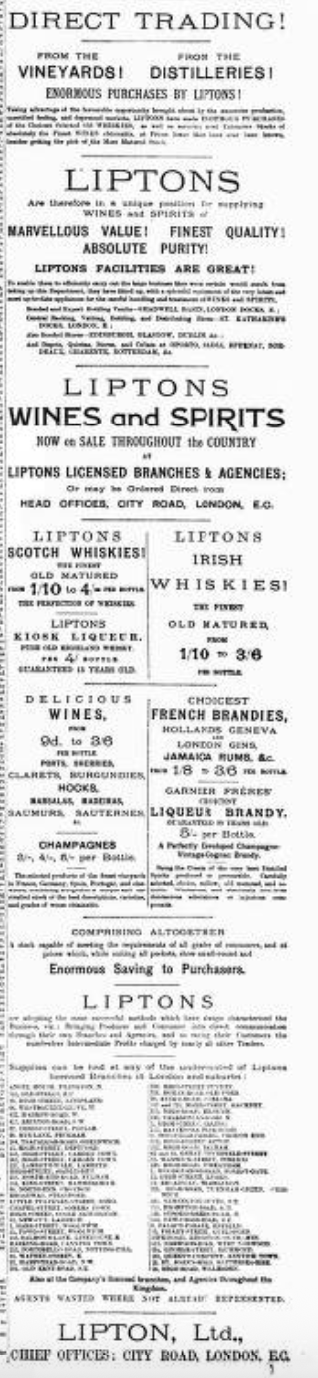
Interestingly, the advert mentions a Pure Old Highland Whisky called Liptons Kiosk Liqueur. This wasn’t a liqueur as we know it today; it was Scotch whisky. Liqueur, I guess, made it sound more premium. And the name emphasises the ‘pure’ and ‘old’ elements – this would have been quite important a couple of years later after certain revelations emerged about the industry during the Pattisons’ trial!
The term ‘kiosk’ would also have had a different connotation back then. It would have evoked a special counter or showcase whisky within Lipton’s larger selection of spirits that were sold in their retail outlets.
Now, there really aren’t that many images of any Lipton’s bottlings available. But I managed to find these minis on Whisky.Auction:

Sir Thomas Johnstone Lipton died in 1931. After his death, the company was subsequently acquired by several different entities. By the early 1980s, though, the Lipton stores had more or less disappeared from the UK’s high streets.
Now, many online sources state that Lipton never married because he was gay. The former, however, isn’t true. But the latter, well, that probably is.
And there’ll be more about this, as well as Lipton the person, and his links to a certain Whisky Baron, for paying subscribers in tomorrow’s follow up email.
Slàinte! Justine