
🥃 Forgotten Names of Glenkinchie Distillery
- Jun 19
- 5 min read
Leechman & Gray
The Scotch whisky industry has always been full of prominent players. But not all have stood the test of time. Let’s take Leechman & Gray for example...
When was the last time you went to a tasting and heard anybody mention them? Or, indeed, when was the last time you read about them? Whereas there are some names we still talk about today, others - such as Leechman & Gray - have quietly disappeared, at best earning only the briefest of mentions in those Scotch whisky reference books we know and love.
Whether a name has endured or disappeared, there’s always a reason - and each reason holds an important lesson in the history of Scotch whisky. If we ignore those lessons, we risk (are currently risking?) repeating the very mistakes that brought some houses down. And so, that’s why - in my opinion, at least - it matters not only to reflect on those who’ve survived, but also those who faded away.
One business I came across while researching and writing Opening the Case was the above mentioned Leechman & Gray. Sounds like some kind of vaudeville double act, doesn’t it?
The real challenge, though, in shaping the book was deciding what to leave out. With the industry so deeply interwoven at the time, it would have been all too easy for each chapter to grow arms and legs, wandering off on endless tangents. Much like my emails, in all fairness.
As a result, Leechman & Gray didn’t receive as much attention in the book as originally planned. But one half of the partnership - the Gray area (see what I did there?) - played a prominent role as an advisor to the liquidators on the proposed scheme to reconstruct Pattisons Ltd as well as valuing the immense stocks of wine and whisky that the collapsed firm held.
So, who were Leechman and Gray? And what happened to them and their business?
Some records state that the company of Leechman & Gray was established in 1868. Others state that it was 1870. Let’s take the former, as I’ve come across more references that use this date.
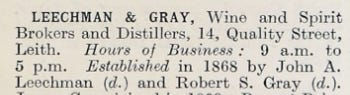
Twenty-five year old John Alexander Leechman and twenty-one year old Robert Sclater Gray based their firm on Quality (now Maritime) Street in Leith alongside neighbours who were also pretty big names at the time:

John Leechman didn’t have any prior links to the Scotch whisky business; his father had been a silk merchant. Robert Gray, on the other hand, was the son of James Gray who had taken over the running of Glenkinchie Distillery in 1840. He only ran the distillery until 1852, though, when one of the owners - John Rate - took back control. Rate subsequently closed it down and sold it; the new owner converting it into a saw mill.
Now, some references mention that James Gray was a partner in the firm of Leechman & Gray. As you can easily work out, this was nearly thirty years before the firm was established so can’t be correct. So, how did that confusion come about?
Well, John Leechman married Isabella McWhirter and together they had four children: three daughters and a son. Robert Gray married Barbara Peterson and they had five children: one daughter and four sons - and one of those sons was called James.
Another James Gray. Now, you can probably see where this is going.
Leechman & Gray became the agents for Glenlossie Distillery. This essentially meant that they were the ones responsible for selling Glenlossie’s make to other brokers and retailers.

But, then, by 1890, they became fully-fledged distillers themselves. Well, kind of.
Glenkinchie had reopened as a distillery in the 1880s by a syndicate of four key businessmen:
1) Robert Harvey Thomson, the well-respected Leith whisky merchant. You can watch a wee video about him here. Spoiler alert: it takes place in a graveyard.

2) James Watt, of Leechman & Gray’s neighbours John A Bertram & Co, another Leith whisky merchant. His father, also called James, had been an apprentice with J.A Bertram before working his way up to become the sole partner of the firm. James Jnr, therefore, followed in his father’s footsteps.

3) J Harrison. Now, I have very little information about him. And when I say little, I mean nothing at all. More digging required.
4) James Hannan, of Alexander Melvin & Co, owners of Boroughloch Brewery in Edinburgh.
And for paid subscribers, there’s some bonus information and photos regarding Melvin and Boroughloch in the follow-up email.
In March 1890, the mysterious Harrison sold his share to Robert Harvey Thomson and Glenkinchie Distillery became a limited liability company.

The Glenkinchie Distillery Company (hey, it does what it says on the tin) comprised of eight members - two each from four Leith firms:
Firstly, John Alexander Leechman and Robert Sclater Gray from - ta-da - Leechman & Gray.
Secondly, the Watt brothers - James and John - from John A Bertram & Co.
Thirdly, Robert Harvey Thomson and his twenty-eight year old son William Alfred Dalziel Thomson. Thankfully, everyone just called him Alfred.
Finally, brothers Arthur and Frederick Reid Sanderson of Robertson, Sanderson & Co. They were the brothers of the famous William Sanderson of VAT69 fame.
In The Glenkinchie Story, Craig Ward states that the deal involved the Sanderson brothers selling as much of Glenkinchie’s whisky as they could to other brokers, retailers etc. Anything that remained was divided between the other three companies who would use it, primarily, for their blends.
Robert Sclater Gray died in 1903 and John Leechman popped his clogs in 1910.


This, in turn, made Robert’s son - James - the sole partner of the business of Leechman & Gray.
In the aftermath of the Pattison crash, several Scotch whisky businesses were struggling. And Glenkinchie was no exception. At the start of July 1914 - with war looming - Glenkinchie along with four other lowland distilling firms joined together to form Scottish Malt Distillers Ltd.
In January the following year, Robert’s son - James Gray - transferred his shares to SMD. Just a few months later - in March 1915 - the firm of Leechman & Gray was wound up.

And in July that year, James - or rather Major James Gray - was killed in action in the Dardanelles.

And this is where the story of Leechman & Gray ends.
In some respects, we could argue that it mirrors the wider story of Scotch whisky itself.
Slàinte! Justine